Bedtime Stories About Outer Space and the Moon
Free to read, no account. Every story on the shelf ends.
The night sky has been a sleeping companion for children since long before electric lights dimmed our view of it. There is something profoundly settling about looking up (or imagining looking up) at stars that are impossibly far away, burning steadily through all of time. A bedtime story set in outer space, when it is told with wonder rather than urgency, invites a child's mind to expand outward and then grow very still, the way the universe itself is mostly stillness interrupted by occasional light.
The moon, in particular, holds a special place in the ritual of going to sleep. Cultures across the world have told children that the moon is watching over them, that it rises as they settle, that it has a journey of its own across the dark. These stories are not just comforting myths: they give children a sense of belonging to something larger and quieter than the busy day that is ending.
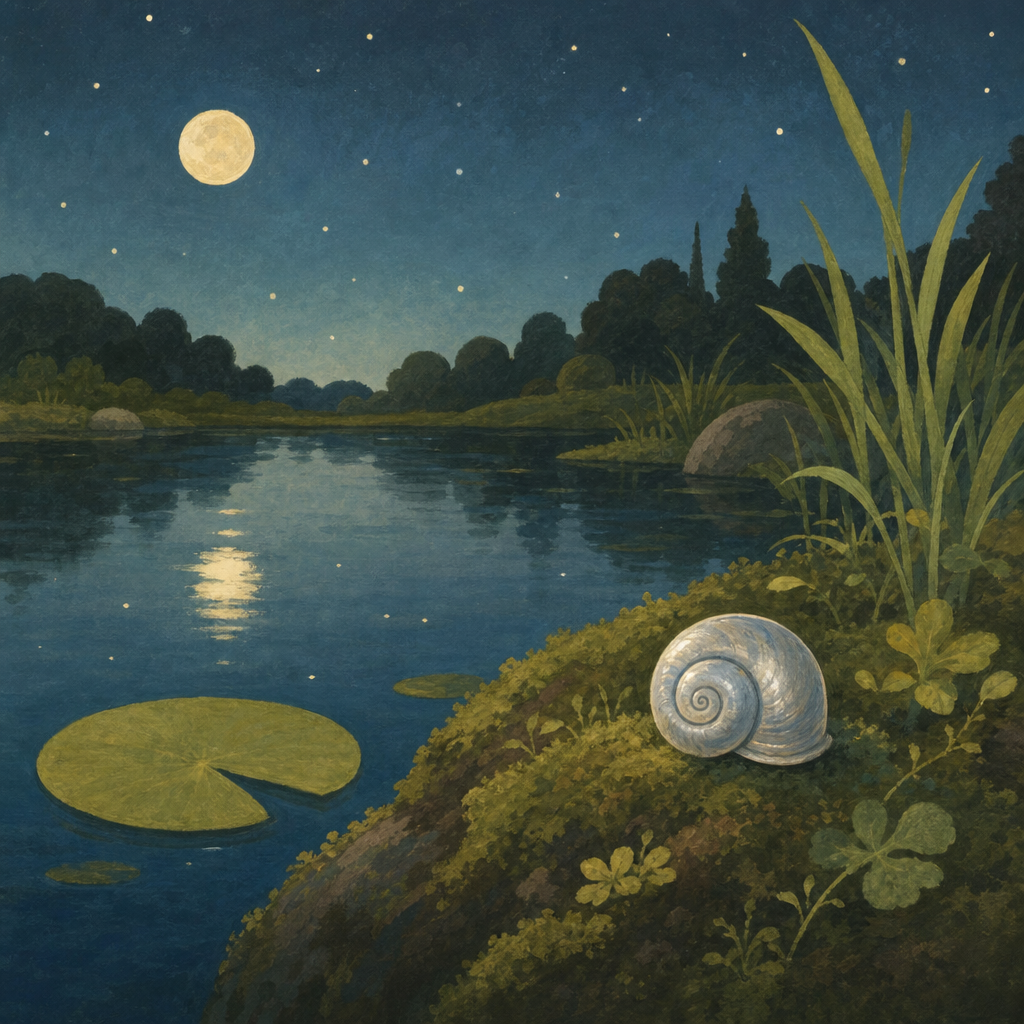
“The Snail Who Carried the Moon”
In the tall wet grass at the edge of the garden, a small snail named Pim woke up when the evening came. The day had been warm, and now the air smelled of rain that had already fallen and gone.
Pim stretched his soft grey body out of his shell, slow as honey.
The grass was cool. The sky was pink. Pim was in no hurry at all.
Read the whole storyThis story is on the shelf for anyone to read. A world you make is written around your own choices.
A world, an ending, seven chapters.
A parent makes a world once, chooses how it ends before the first word, and reads a book of seven connected chapters aloud, whenever the family likes.
Choose a place.
Pick a setting and a few characters, or add your own. Match the reading age to your child.
Choose how it ends.
Everyone comes home, something is given away, or the characters stay in their world. You decide before the book begins.
Read together.
Preview each chapter when you have time. Read aloud whenever it suits your family, alongside the paper books you enjoy.
The first book is free. Every book after it begins with a free chapter, and the rest of the book is $14, once. Read whenever you like. No subscription. Introductory price.
Make a worldCommon questions
Why do children find outer space calming at bedtime?
The silence and scale of space can have a paradoxically settling effect on busy young minds. Stories set in space naturally slow the pace: there's no traffic, no noise, no rushing, just the slow arc of a spacecraft and the steady light of distant stars. Children who struggle to quiet their thoughts sometimes find that imagining the enormous, patient stillness of space gives their minds somewhere peaceful to rest.
Are space bedtime stories suitable for young children (under 5)?
Yes, especially when focused on the moon and stars rather than technical space travel. Young children respond beautifully to the moon as a companion: it rises when they sleep, it watches over the neighbourhood, it has a gentle, reliable presence. Stories that treat the moon as a warm, familiar character rather than a scientific object work wonderfully from around age 2 and up.
How does a bedtime space story handle the vastness of space without overwhelming children?
By zooming in. Rather than trying to encompass the entire universe, a good bedtime space story focuses on one small window, one particular star, one quiet moment aboard a spacecraft. The enormity is present as a felt sense, a backdrop, but the child's experience is intimate and specific. It's the difference between describing the ocean and describing the feeling of one wave washing over your feet.
Can I make a world around this theme?
Yes. In the workshop you pick a place and who lives there, or describe your own, and add anything that must never happen. You can name your child if you like. Then you choose how the book ends, before the first word, and read its seven chapters aloud whenever suits your family.
What does it cost?
The first book is free. Every book after it begins with a free chapter, and the rest of the book is $14, once. Read whenever you like. No subscription. Introductory price.
Do I need an account to read a story?
No. The stories in the free library open with no account. An account is for keeping a world of your own.