The Lamplighter of Willow Lane
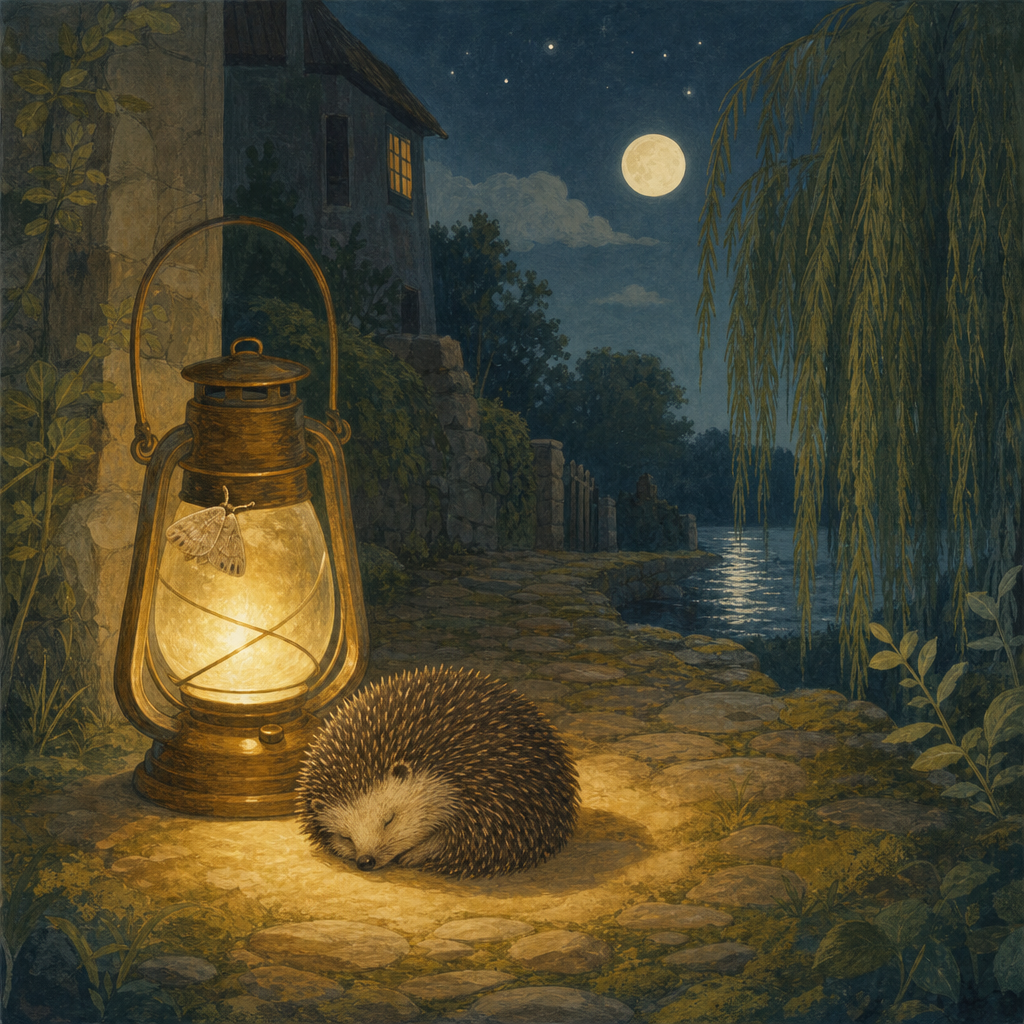
In a town where the streets curled like ribbons and the rooftops leaned close to whisper to one another, there lived a small brass lantern named Pip. Pip hung from the arm of an old iron lamppost at the very end of Willow Lane, where the cobblestones grew soft with moss and the houses gave way to a hush of trees.
Every evening, when the sky turned the color of a ripe plum, Pip woke. His little flame stretched and yawned inside his glass, and he looked out at the lane he had watched over for a hundred quiet years.
The plum sky deepened.
The wind moved slow.
Pip began to glow.
His was the last light on the lane, and this made his work important in a gentle way. The other lamps stood in a long row up the hill, each one blinking awake in turn, until the whole street was strung with soft gold, like beads on a thread. Pip was always the last bead. He liked being last. It meant that when a traveler came home late along Willow Lane, his was the light that said, almost there now, almost home.
Tonight, the lane was still. A snail crossed the cobbles with great patience. A moth came to visit, circling once, twice, then settling on the warm glass to rest its dusty wings.
"Cold out?" Pip asked, for he was a friendly sort of lantern.
"Only a little," said the moth. "You are the warmest thing on the lane."
And Pip was glad of the company, for the night was long, and a light shines better when someone sits beside it.
The evening unrolled the way evenings do. A cat with white socks padded home along the wall top. Somewhere a window opened, and the smell of bread and butter drifted down, and then the window closed again, gentle as a sigh. An owl called from the willows — not a frightening sound, only a soft round question sent out into the dark, the way one might hum to oneself.
The snail moved on.
The bread smell faded.
Pip glowed, and glowed.
When the moon rose, it came up round and full behind the willow trees, and it seemed to Pip that the moon was simply the largest lamp of all — a great silver lantern that some far-off, patient hand had lit for the whole sleeping world. The moon did not flicker. The moon did not worry. It only shone, steady and calm, and Pip tried to shine the same way, and found that he could.
The moth stirred on the glass. "Do you ever grow tired," it asked, "of shining every single night?"
Pip thought about this the way old lanterns think, slowly and without hurry.
"No," he said at last. "Because I am not shining for tomorrow. I am only shining for now. And now is a small thing, and I can hold it."
The moth liked this answer, and folded its wings, and said nothing more.
The hours drifted by like leaves on water. One by one, the beads of light up the hill winked out as the town went to sleep — first the baker's lamp, then the tall lamp by the fountain, then the little crooked one outside the toy shop. The row grew shorter and shorter, until at last only Pip remained, burning low and soft at the end of Willow Lane.
He did not mind. Below him, a small creature had come to curl in the warm circle he cast on the cobbles — a hedgehog, round as a bun, tucked into the pool of gold. Pip lowered his flame a little, so as not to shine in the hedgehog's eyes, and the hedgehog breathed slow, and the moth breathed slow, and the willows breathed slowest of all, swaying just enough to stir the moonlight.
The lane was quiet.
The moon was high.
Everything was warm.
Pip felt his flame settle, small and steady and content. He was the last light, and the last light does not need to burn bright. It only needs to stay, gentle and true, through the deep middle of the night, so that anything awake and wandering knows it is not alone.
The moon shone. The willows swayed. And the little brass lantern glowed low over the sleeping lane, warm as a held hand, quiet as a breath let go.
The hedgehog gave a small, soft snore.
And Pip glowed on, and the night held them both, and all along Willow Lane it was still.