The Lamplighter Snail
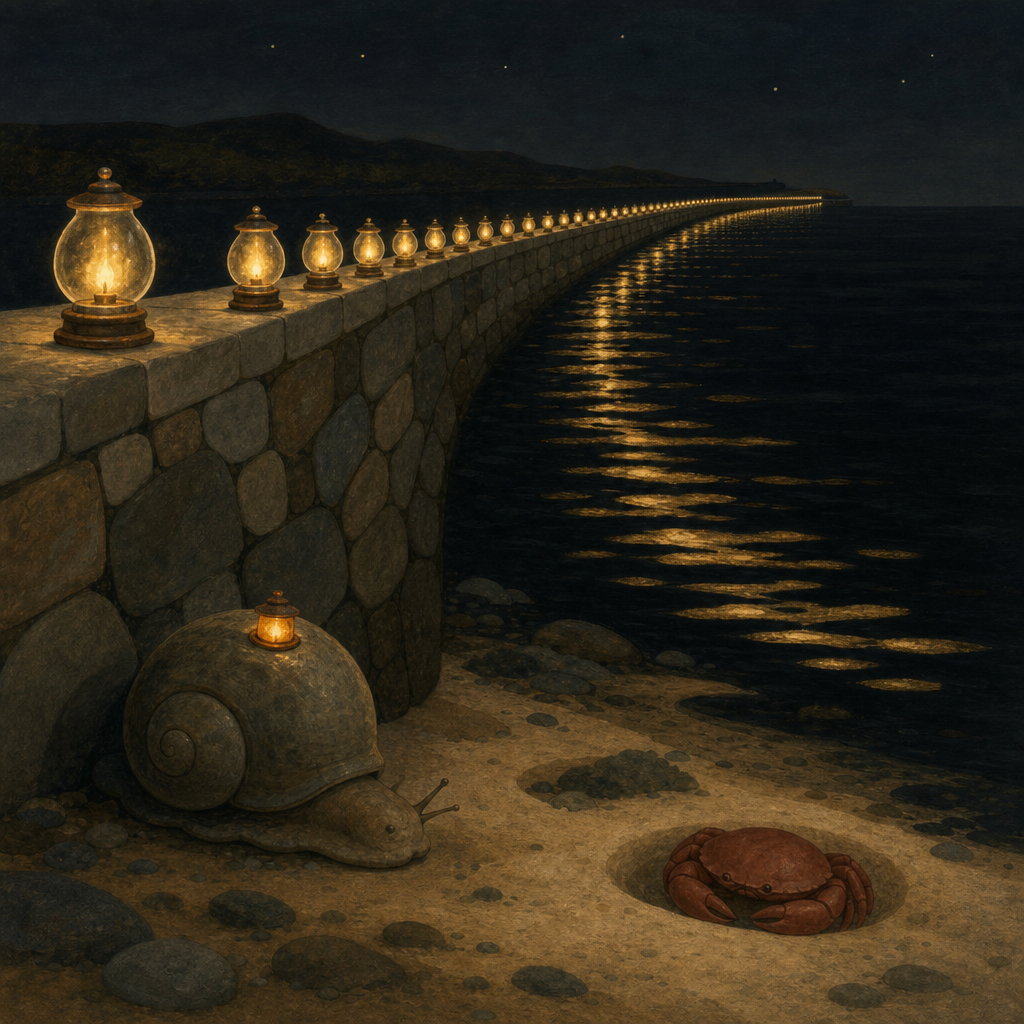
In the hour when the harbor town went blue with evening, a snail named Perl left her shell of polished stone and set out along the sea wall. She carried a tiny lantern on her back, no bigger than a thimble, and inside it a single warm spark.
The wall was long. The wall was cool. The wall was hers to keep.
Perl's task was an old one, older than the barnacles that clung below her. Along the sea wall stood a hundred small glass lamps, and each night she lit them one by one, so the fishing boats coming home could find the harbor mouth.
The tide was low.
The gulls were quiet.
The first star opened its eye.
She touched her spark to the nearest lamp, and it bloomed gold.
"One," said Perl softly, for she liked to count her way along.
The wall was long. The wall was cool. The wall was hers to keep.
As she inched toward the second lamp, a crab sidestepped out of a crack in the stone, waving one claw in a slow hello. He was the color of wet brick, and he moved the way crabs do, everywhere and nowhere at once.
"You're early tonight, Perl," the crab said. "Or the dark is late. I never can tell."
"The dark comes when it comes," said Perl. "I only meet it with light."
The crab clicked his claw, pleased with this, and scuttled beside her to the second lamp. She lit it. Gold spilled across the crab's shell and turned him briefly to copper.
"Two," said Perl.
The wall was long. The wall was cool. And now it was a little warmer for the glow.
They went on together, the snail and the crab, past clumps of dark seaweed that smelled of salt and green and deep places. At the seventh lamp, a small fish leapt from the water below, hung silver in the air for one heartbeat, and dropped back with a plip. Perl did not startle. She had lit these lamps ten thousand nights, and she knew the sea liked to show off when the lamps came on.
"Seven," she said, and the fish, if it heard, said nothing back.
The water lapped.
The wall glowed.
Everything moved slowly now.
By the twentieth lamp, the crab grew sleepy and burrowed into a soft pocket of sand at the wall's foot. "I'll watch the light from here," he said, yawning sideways. "Wake the whole coast, Perl. Gently."
"Gently," she agreed. "Always gently."
The wall was long. The wall was cool. And Perl went on alone, which did not feel like being alone at all, with so many small flames waking behind her.
The lamps threw their light onto the black water, and each reflection wobbled and stretched and settled, so that the harbor filled up with soft yellow ribbons. Out past the harbor mouth, where the sea went wide and dark, a single boat turned its nose toward home. Perl could just see its shape against the deeper night. She did not hurry. She never hurried. A snail who hurries drops her spark, and a dropped spark helps no one.
So she lit the thirtieth lamp, and the fortieth, counting under her breath, her small foot rippling over the cool stone. The boat drew nearer with every flame. It followed the ribbons of light the way a child follows a hand held out in the dark.
The boat came closer.
The lamps stood in a golden line.
The harbor held them all.
At the ninetieth lamp, Perl paused to rest, tucking herself half into her shell, feeling the good ache of a night's slow work. Below her, the crab breathed in his sandy pocket. Somewhere the silver fish turned in its sleep. The boat slipped past the harbor mouth and into calm water, and a rope thumped softly against a post as someone tied it fast.
The wall was long, and now nearly lit. The wall was cool, but her lantern was warm. The wall was hers, and she had kept it.
"Ninety-nine," said Perl, touching the last-but-one to life.
Only one lamp remained, the smallest, at the very end of the wall where the stone met the soft dark of the shore. Perl crept to it, unhurried, her spark still steady on her back. She leaned close. The glass warmed against her.
"A hundred," she whispered, and the last flame opened like a slow gold flower.
The whole wall shone now, a long soft curve of light along the sleeping harbor. The boat was home. The crab was buried warm. The fish drifted below in ribbons of gold.
Perl settled into her shell of polished stone, the lantern glowing low against her side, its little spark banked and quiet for the night. The lamps would hold the dark until morning. She had only to rest.
The water lapped the wall, slow and even, the way breath comes when the day is done.
The wall was warm. The light was steady. And the harbor kept its hundred small flames burning, on and on, into the quiet.