The Hiccuping Teapot
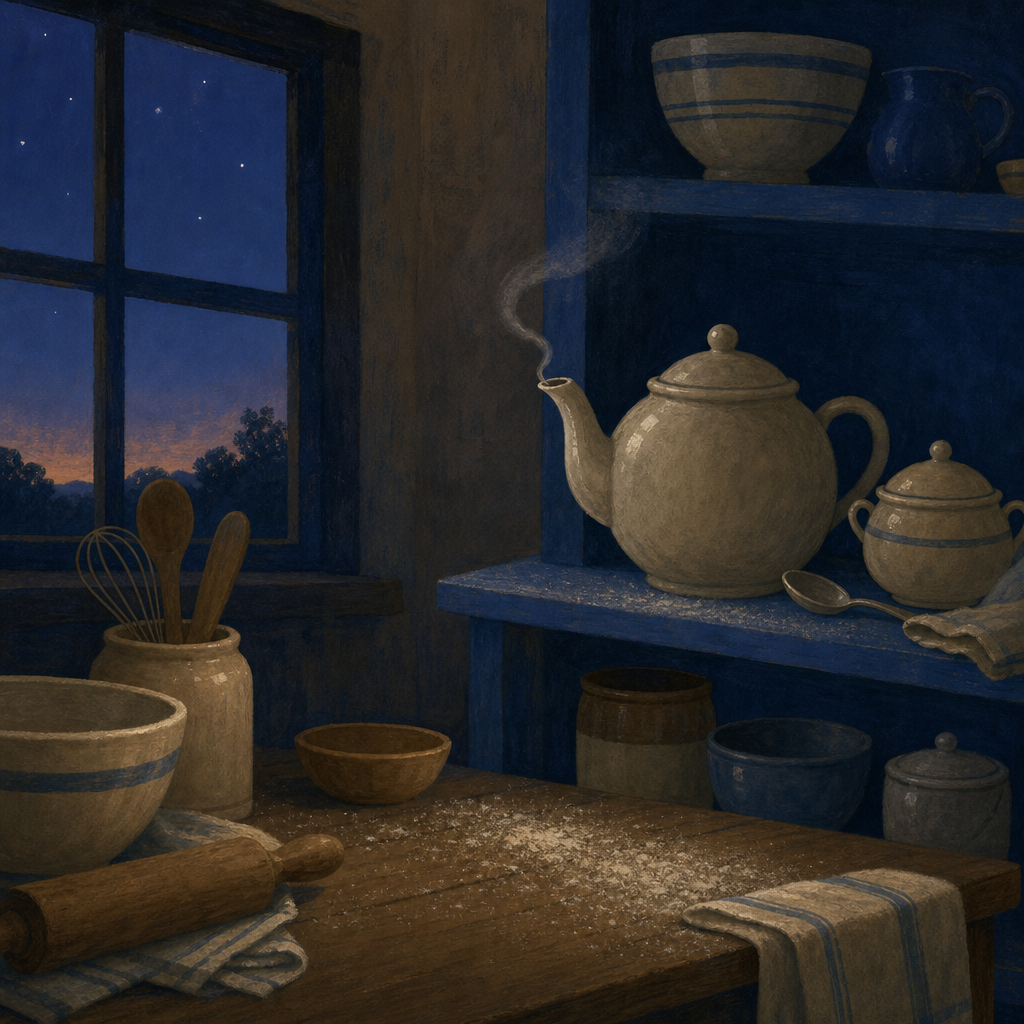
On a shelf in a warm kitchen lived a round blue teapot named Pip, and Pip had the hiccups.
Not ordinary hiccups. Teapot hiccups.
Each one went HIC — and out the spout puffed a little cloud of steam shaped like something. A steam mouse. A steam boat. A steam question mark that hung in the air, wondering.
HIC. Steam cloud. HIC. Another one. HIC. And the whole shelf giggled.
"Try holding your breath," said the sugar bowl, who was very organized and liked to help.
Pip tried. Pip's cheeks — if a teapot can be said to have cheeks — puffed out round and blue and enormous. Pip held. Pip held some more. Pip turned a deeper shade of blue.
HIC.
Out came a steam elephant, trunk and all, drifting up toward the ceiling before it melted into nothing. The elephant seemed rather pleased with itself.
"Hmm," said the sugar bowl. "That did not work."
HIC,* said Pip. *And the kitchen was warm. And the kitchen was full of little clouds.
The wooden spoon had an idea. The wooden spoon always had ideas, and they were always, always terrible, which was exactly why everyone loved him.
"You must be FRIGHTENED out of them," announced the spoon. "It is well known. I shall leap from the jar and shout BOO."
He climbed the rim of his jar. He wobbled. He balanced on one splintery end like a tiny wooden acrobat.
"BOO!" cried the spoon — and toppled — THUMP — straight into the flour.
FWOOMP.
A great white puff went up. When it cleared, the spoon was a ghost, entirely coated, blinking two clean brown eyes out of a face of flour.
"Did it work?" asked the flour-ghost spoon.
HIC, said Pip. Out floated a steam spoon. It also appeared to be a ghost.
The whole shelf laughed so hard the teacups rattled in their saucers.
The teacups tipped. The teacups rang. The spoon dripped flour on the floor.
Now the honey jar, who was slow and sweet and rarely said anything, spoke up from the corner in a voice like warm syrup.
"Sing," said the honey jar. "I always feel better when I hum."
So they sang. The sugar bowl kept the beat, tapping her lid. The teacups chimed. The flour-ghost spoon conducted with one dripping arm, flinging little snowflakes of flour with every wave. And Pip sang too, in a bubbling, whistling, kettle-warm voice —
HIC — went the middle of the song. HIC — went the end of every line.
And here is the strange and wonderful thing. Nobody minded the hiccups anymore. The hiccups had become part of the song. When Pip went HIC, a steam shape rose — a steam bird, a steam wave, a steam curl of ribbon — and everyone pointed and named it before it faded.
"A fish!" "A crown!" "A very small hat!"
The kitchen filled with drifting silver shapes, rising and softening and disappearing, and the singing went round and round, warm and silly and full of flour.
HIC. A cloud. HIC. Another.
And then — nobody quite noticed when — the HICs began to slow.
The song grew softer. The teacups stopped their rattling and only glowed. The flour settled, a fine white dust going quiet on the wooden boards. The spoon sat down in his jar, tired and happy and still a little bit of a ghost, and let his eyes go heavy.
Outside, the light in the window turned from gold to grey to the deep soft blue of Pip's own round belly.
The kitchen was warm. The kitchen was slow.
Pip breathed in. Pip breathed out.
And no cloud came.
Pip waited for the HIC. It did not arrive. Only warmth moved through Pip now, slow and even, the last of the evening's tea holding its heat like a small kept sun.
The sugar bowl closed her lid. The honey jar hummed one low last note, and let it trail away into nothing.
One steam shape remained, high near the ceiling — a little round teapot, drawn in silver, with a curl of steam for a spout. It hung there a moment in the last of the light. Then it softened, and thinned, and was gone.
The kitchen was quiet. The kitchen was blue.
And on the warm shelf, breathing slow, Pip grew still.