Bedtime Stories About Owls
Free to read, no account. Every story on the shelf ends.
The owl is the gentle guardian of the night, and that alone makes it one of the most reassuring companions a bedtime story can offer. While the rest of the wood sleeps, the owl is awake: not anxiously, not restlessly, but calmly and competently, keeping its quiet watch from a high branch. For a child who is sometimes uneasy about the dark, there is deep comfort in a creature who is entirely at home in it, who finds the night not frightening but ordinary and even beautiful. The owl knows the dark the way the child knows their own bedroom, and a story told from the owl's perspective lets the child borrow that easy, settled confidence.
Owls also move through the world almost silently, and that silence is itself a kind of lullaby. The famous softness of an owl's flight (feathers edged so finely that they make no sound at all) gives owl stories a natural hush. There is no clatter, no rush, only the slow turn of a round head, the patient blink of large eyes, the soundless opening of broad wings. A story that dwells on this quiet teaches a busy mind, gently and without instruction, how to grow quiet too.
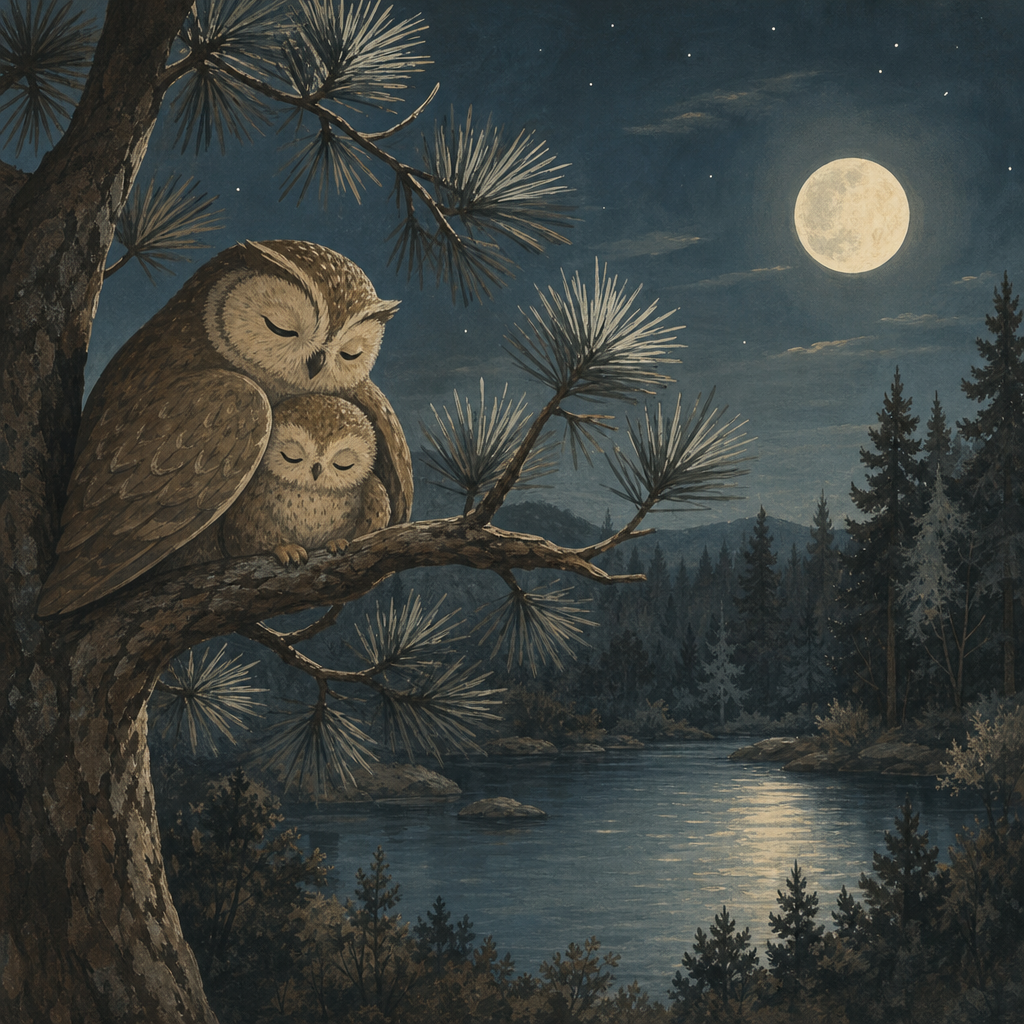
“The Little Owl and the Dark”
High in the old pine tree, a little owl sat close to her mother. The night was soft. The night was new.
"I want to fly," said the little owl. Her voice was small. "But the dark is so big."
Her mother tucked a wing around her. "The dark is big," she said. "And you are brave. Both can be true."
Read the whole storyThis story is on the shelf for anyone to read. A world you make is written around your own choices.
A world, an ending, seven chapters.
A parent makes a world once, chooses how it ends before the first word, and reads a book of seven connected chapters aloud, whenever the family likes.
Choose a place.
Pick a setting and a few characters, or add your own. Match the reading age to your child.
Choose how it ends.
Everyone comes home, something is given away, or the characters stay in their world. You decide before the book begins.
Read together.
Preview each chapter when you have time. Read aloud whenever it suits your family, alongside the paper books you enjoy.
The first book is free. Every book after it begins with a free chapter, and the rest of the book is $14, once. Read whenever you like. No subscription. Introductory price.
Make a worldCommon questions
Are owl stories good for children who are afraid of the dark?
They can be especially helpful. The owl is a creature entirely at ease in the dark, calm, capable, and content there, and a story told from its perspective lets an anxious child experience the night as ordinary and even beautiful rather than frightening. An owl who treats the dark wood as a safe and familiar home can gently reshape a child's relationship with the dark.
Will an owl story include scary hunting or frightening moments?
It need not. A bedtime owl story can focus on the owl's calm watchfulness, its silent flight, and the quiet beauty of the night wood, not on hunting or peril. The mood is hushed and protective throughout, with the owl as a gentle guardian of the night rather than a predator.
What makes owls particularly suited to bedtime stories?
Owls are silent, slow-moving, and serenely awake in the dark: qualities that lend an owl story a natural quiet. Their soundless flight and patient, unhurried presence model exactly the stillness a child is being invited into at bedtime, and a guardian who keeps calm watch while everything else sleeps is deeply reassuring.
What age range enjoys owl bedtime stories most?
Owl stories work well from about age 3 to 9. Younger children love the big eyes, the soft feathers, and the idea of a gentle creature watching over the night; older children enjoy the naturalist detail: the silent flight, the sounds of the dark wood, the sense of a whole quiet world going about its business while they sleep.
Can I make a world around this theme?
Yes. In the workshop you pick a place and who lives there, or describe your own, and add anything that must never happen. You can name your child if you like. Then you choose how the book ends, before the first word, and read its seven chapters aloud whenever suits your family.
What does it cost?
The first book is free. Every book after it begins with a free chapter, and the rest of the book is $14, once. Read whenever you like. No subscription. Introductory price.